
- Home
- Volume
- Pool volume calculator
Pool Volume Calculator
Gallons and liters for any pool shape from three measurements.
1 of 3
Your gallons appear here after step 3.
- 7.48
- gallons in one cubic foot
- 3.785
- liters in one US gallon
- (shallow + deep) / 2
- average depth for a sloped floor
Enter your pool's length, width and average depth, and this calculator shows the pool volume in gallons or liters. We'll also remember the gallons in your browser and fill them in on every dose calculator, so you only measure once. You want that figure on hand before you treat the water, since the right amount of any chemical depends on the size of the pool it's going into.
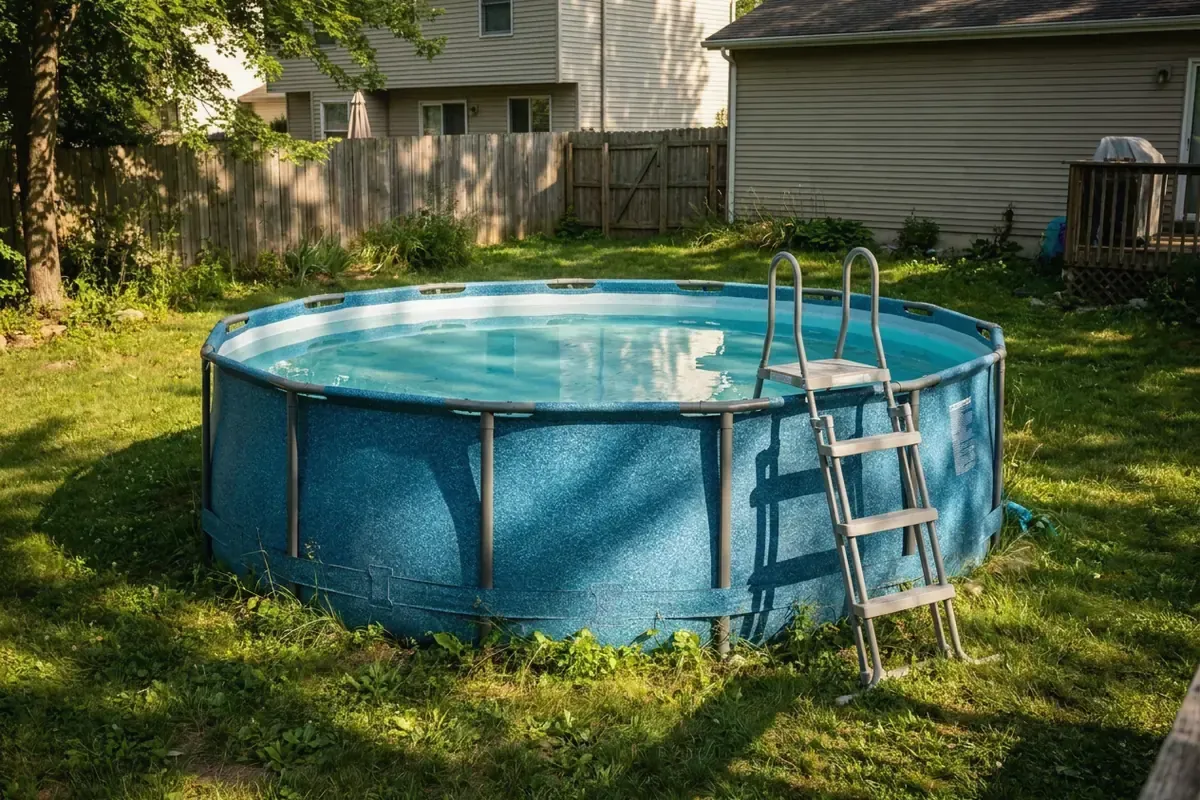
Gallons by pool size: a quick reference
These estimates assume an average water depth of 4.5 feet; your pool may differ. Go deeper and the pool holds more. Go shallower and it holds less.
| Pool | Gallons | Liters |
|---|---|---|
| 12 x 24 ft rectangle, 4.5 ft average depth | 9,690 | 36,700 |
| 16 x 32 ft rectangle, 4.5 ft average depth | 17,240 | 65,200 |
| 20 x 40 ft rectangle, 4.5 ft average depth | 26,930 | 101,900 |
| 15 ft round, 48 in wall (42 in of water) | 4,630 | 17,500 |
| 18 ft round, 48 in wall (42 in of water) | 6,660 | 25,200 |
| 24 ft round, 52 in wall (46 in of water) | 12,970 | 49,100 |
| 15 x 30 ft oval, 52 in wall (46 in of water) | 10,130 | 38,400 |
| 18 x 33 ft oval, 52 in wall (46 in of water) | 13,380 | 50,600 |
For a dose listed per 10,000 gallons, double it for a 20,000 gallon pool or halve it for a 5,000 gallon pool.
How do you calculate pool volume?
The average depth sits right between your shallow end and your deep end. When the floor is flat, the water's depth is the average all on its own.
- 1. Measure the water's length and width in feet.
- 2. Measure both ends, add the two depths together, then divide by two. That's your average depth.
- 3. For a rectangular pool, multiply length by width, then by the average depth.
- 4. Take that result and multiply by 7.48 for gallons. For a round or oval pool, put 5.9 where 7.48 would go.
Say your pool measures 16 x 32 feet, with one end at 3 feet of water and the other at 6. The average depth works out to 4.5 feet, and the pool holds around 17,200 gallons.
A round pool 24 feet across with 4 feet of water holds 24 x 24 x 4 x 5.9 gallons.
The pool volume formula
In short, surface area times average depth times 7.48 gives gallons, since a cubic foot of water is about 7.48 gallons.
- Rectangle: length times width times average depth, times 7.48
- Round: diameter times diameter times average depth, times 5.9
- Oval: length times width times average depth, times 5.9
- Sloped floor, average depth: half the sum of the shallow end and the deep end
Pool volume in liters
Got your US gallons? Multiply by 3.785 to get liters. A pool with 15,000 gallons works out to roughly 56,800 liters.
Working in meters instead? Multiply length by width by average depth and you get cubic meters. Since each cubic meter is 1,000 liters, a pool of 50 cubic meters comes to 50,000 liters.
Questions people often ask
Is an inground pool measured differently?
No. Inground or above ground, you need the same three things: the shape, the length and width, and the average depth.
Why does 5.9 replace 7.48 for round and oval pools?
A curved pool doesn't hold as much water as a rectangle matching it in length and width. The 5.9 folds the curve and the gallons per cubic foot together into one number, so you can plug your measurements straight in.