
- Home
- Chemicals
- Lower pH
How to Lower pH in a Pool
Muriatic acid is the usual fix. Two answers give the amount for your pool.
1 of 2: your gallons
Your dose appears here after the last question.
- 31.45%
- common muriatic acid strength
- 30 min
- with the pump on before retesting
- 7.5
- pH we dose to
To lower pH in a pool, run the pump, pour a measured dose of muriatic acid in front of a return jet, wait half an hour, and test again. A 10,000-gallon pool needs 9 fl oz of muriatic acid at 31.45% strength to drop from a pH of 7.8 to 7.5.
- What you usually need: muriatic acid, 31.45% strength
- Amount per 10,000 gallons: 9 fl oz (equal to 270 mL) for a drop from pH 7.8 to 7.5
- Where you want pH: 7.4 to 7.6
- When to retest: 30 minutes after the acid goes in
What should pH be?
Aim to hold pH at 7.4 to 7.6. Readings from 7.2 up to 7.8 are all acceptable. Above 7.8 is too high, and that's when it's time to add a little acid and bring it back down.
Check total alkalinity too, if your test measures it. The target range is 80 to 120 ppm. Ppm is short for parts per million. It's simply a way of stating how much of something is dissolved in the water, and it's the figure your test reports.
How much acid do you need?
How much acid you need comes down to how big your pool is. All of these doses call for 31.45% muriatic acid and work for pools with normal alkalinity. Each dose moves the pH from 7.8 down to 7.5.
| Size of pool | Acid in fl oz |
|---|---|
| 5,000 gallons | 4.5 |
| 10,000 gallons | 9 |
| 20,000 gallons | 18 |
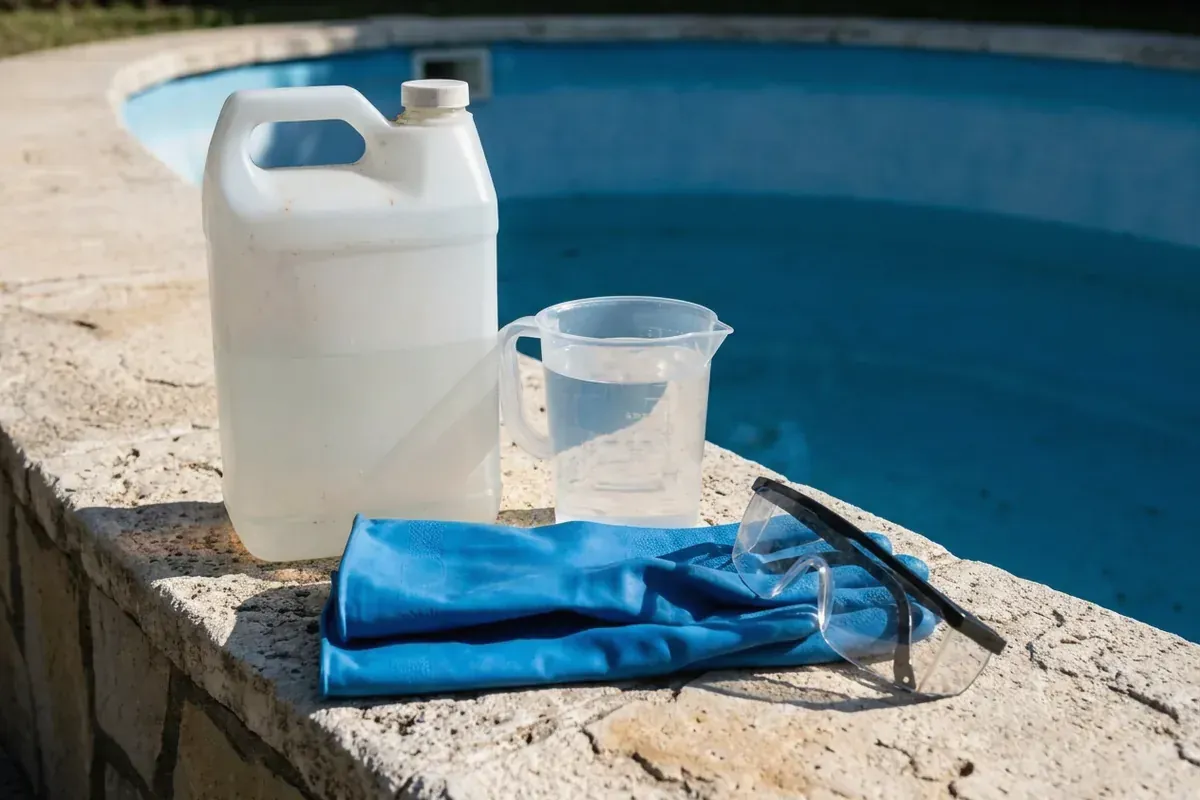
Measure the dose for your pool rather than pouring straight from the jug.
For example, a 12 by 24 ft pool averaging 4.5 ft deep holds roughly 9,690 gallons. That's nearly 10,000 gallons, so 9 fl oz or so is the dose to use.
Adding the acid safely
Add the acid where moving water carries it away fast. One thing that helps is a return jet, the small opening in the wall of the pool that sends filtered water back out into the pool.
- 1. Start the pump and leave it on while you pour.
- 2. Get your measurement ready beforehand. Acid always goes into water, never water into acid.
- 3. Pour slowly, right in front of a return jet.
- 4. Put in one chemical at a time, and keep acid and chlorine apart.
Testing again after 30 minutes
Give it 30 minutes with the pump on, then run another pH test. If the pH is still high, work out a new dose for your current reading, since the table only covers a drop from 7.8 to 7.5. If it has dropped below 7.2, soda ash will bring it back up.
Can you lower pH without lowering alkalinity?
Acid lowers alkalinity as well as pH, so the doses in the table work best when alkalinity is in its normal range of 80 to 120 ppm. If you keep adding acid often, check alkalinity too, because it may be drifting low. If your goal is to lower alkalinity itself, you'll need more acid: 26 fl oz (755 mL) drops it by 10 ppm in a 10,000-gallon pool.
Finding your pool's gallons
Everything here is measured in US gallons, so knowing your pool's volume pays off. These popular sizes all assume the water averages 4.5 ft deep:
| Dimensions | Approximate volume |
|---|---|
| 12 x 24 ft | ≈ 9,690 gal |
| 16 x 32 ft | ≈ 17,200 gal |
| 20 x 40 ft | ≈ 26,900 gal |
This website stores your gallon figure in your browser and plugs it into each dose calculator for you.
How this is worked out
Not sure how many gallons you have? Find the closest size in the table, or multiply length by width by average depth, all in feet, then by 7.48 (use 5.9 for a round or oval pool). If the bottom slopes, average the depths by adding the shallow end to the deep end and dividing by 2.