
- Home
- Equipment
- Paint calculator
Pool Paint Calculator
Two answers give the area of floor and walls and the gallons of paint for two coats.
1 of 2
Your paint amount appears here.
- 250 sq ft
- per gallon per coat, a common rate
- 2 coats
- on most repaints
- +1 gal
- for rough or bare plaster
A pool paint calculator figures out how much surface you have, meaning the floor plus the walls, and then how many gallons of paint will cover it. Your pool's size and depth decide how much you need. Measure it first, then use the coverage figure on your paint can.
- Check the coverage printed on your paint can, since it varies by brand and type, and use that number in the calculator.
- Check the paint can for how many coats it recommends.
- Rough or bare plaster soaks up more paint than a smooth painted surface, so it's worth buying a little extra.
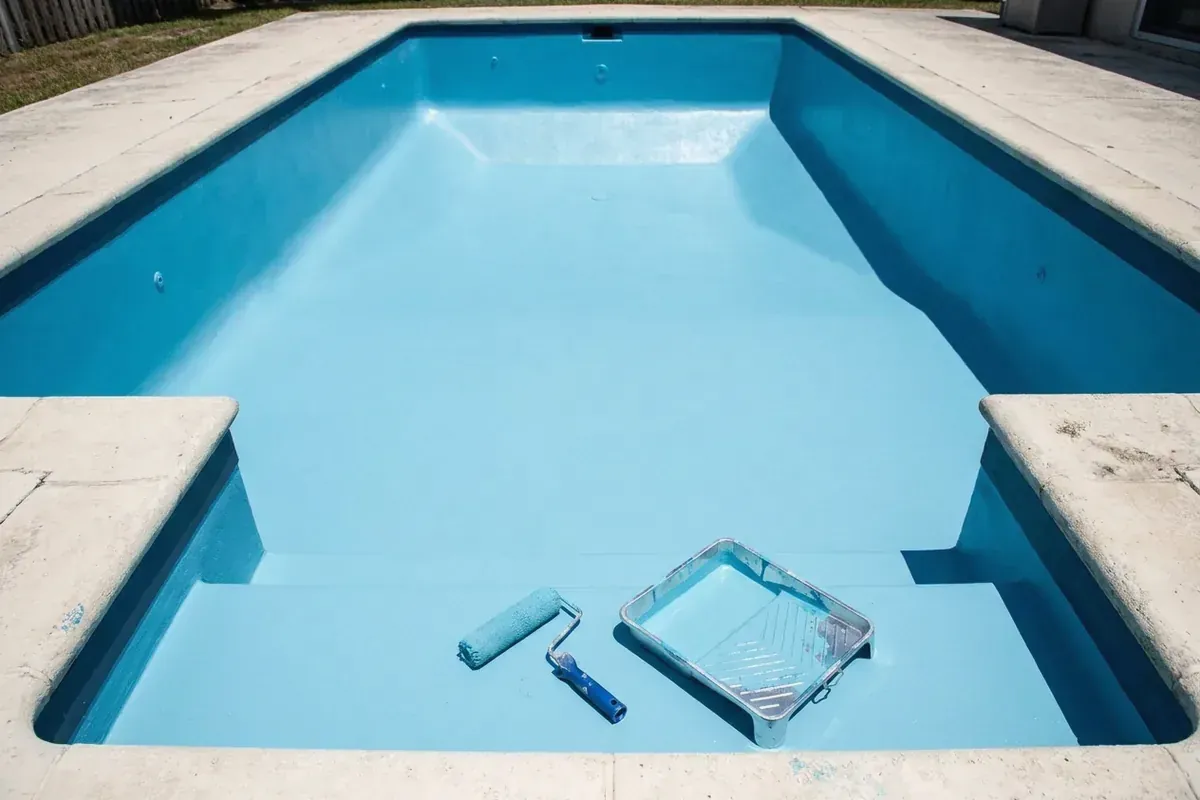
Working out the pool's surface area, floor and walls
Every surface under the water gets painted, so the floor and all 4 walls count as part of the area. You only need 3 measurements: length, width, and average depth.
The average depth is simply the depth at the midpoint between the shallow and deep ends. Say one end of your pool is 3 feet deep and the other is 8 feet. Halfway between those is 5.5 feet, and that's your average depth.
- 1. Start by measuring how long and how wide the pool is, in feet.
- 2. Next, check the depth at both the shallow end and the deep end.
- 3. Split the difference between those 2 depths to get your average.
- 4. Plug all 3 numbers in, and you'll get the combined floor and wall area in square feet.
That same area figure works for pricing plaster or tile too, so keep it handy.
Paint needed by pool size
Here are some typical rectangular pools and their floor and wall area.
| Pool size | Average depth | Floor and wall area |
|---|---|---|
| 12 x 24 feet | 4.5 feet | 612 square feet |
| 16 x 32 feet | 5 feet | 992 square feet |
| 18 x 36 feet | 5 feet | 1,188 square feet |
| 20 x 40 feet | 5.5 feet | 1,460 square feet |
Pool paint is sold by the gallon, so round up to a whole gallon when you buy.
Will rough or bare plaster take more paint?
Yes. Paint soaks into rough or bare plaster more than into a surface that's smooth and already painted. Check the paint manufacturer's guidance for rough or bare plaster before deciding how much extra to buy.
Do two coats of pool paint do the job?
Check the paint can for how many coats it recommends, and multiply your surface area by that number of coats.
Figuring plaster and waterline tile
Plaster and resurfacing jobs are priced per square foot of the whole surface, which is that same floor and wall area used for paint. Picture a 20 x 40 foot pool that averages 5.5 feet deep. You'd be pricing out about 1,460 square feet of surface.
Waterline tile is the strip of tile running along the top edge of the walls. To get its area, multiply the distance around the pool by the height of the tile strip, which is often 6 inches. So a 6 inch strip of tile covers half a square foot for each foot around the pool.
How this is worked out
Length times width gives the floor area. For the walls, multiply the pool's perimeter by its average depth. Put those together and you have the full surface:
- The floor is the length multiplied by the width
- For the walls, measure the distance around the pool and multiply it by the average depth.
- Add the floor and the walls together for the total surface
When a floor slopes, work out its average by adding the shallow depth to the deep depth and halving the result.
For paint, take the surface area, multiply by the number of coats, divide by the coverage per gallon, and round up to a whole gallon.
Waterline tile comes from the pool's perimeter times how tall the tile strip is, measured in feet. Since 6 inches works out to half a foot:
- Figure the tile by doubling the length, doubling the width, adding them, then multiplying by the band height