
- Home
- Chemicals
- Chemicals for beginners
Pool Chemicals for Beginners
Six things to buy, one test kit, and the order to use them.
Pool chemicals for beginners come down to a short list: a way to test the water, chlorine, and products to adjust pH. You can buy the other chemicals when a test shows you need them. Most outdoor pools try to stay around these levels:
- pH: aim between 7.4 and 7.6
- Free chlorine: 3–5 ppm while stabilizer reads 30 ppm
- Total alkalinity: somewhere in the 80–120 ppm band
- Stabilizer: 30–50 ppm
Start here: the order to use them
Your pool: not measured yet. Find your gallons, then get your doses.
- 1. Find your gallons with the pool volume calculator.
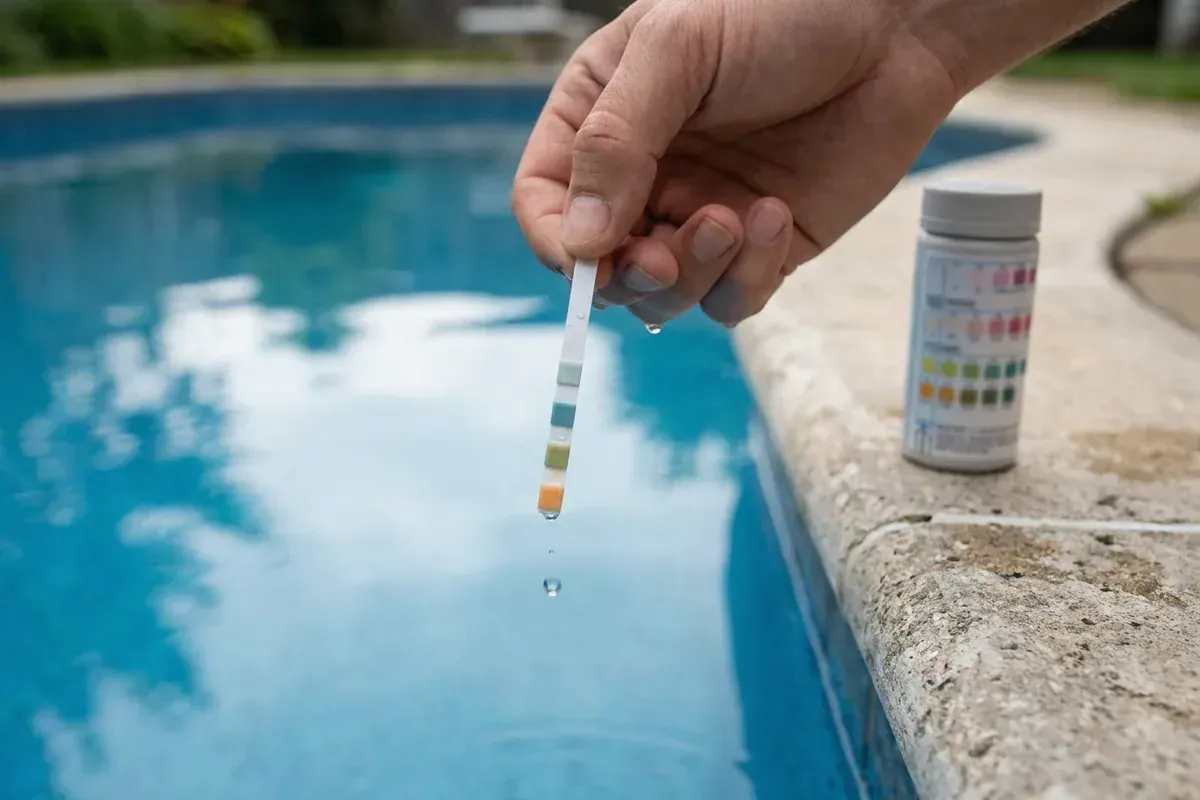
- 2. Test free chlorine, pH, alkalinity and stabilizer with a strip or a drop kit.
- 3. Fix alkalinity first, then pH, then chlorine.
- 4. Get each amount for your pool from the pool chemical calculator.
- 5. Add one chemical at a time in front of a return jet, with the pump running.
- 6. Wait 30 minutes, test again, and only then add more.
Chemicals to buy first
You can start without filling a whole shelf. This short list handles nearly everything a home pool asks for:
- Test strips when you want a fast answer, or a kit that uses drops
- 12.5% liquid chlorine; if you have a salt cell, follow its manufacturer's salt target
- Muriatic acid for bringing pH down
- Soda ash for bringing pH up
- Baking soda, which lifts alkalinity
- Stabilizer (cyanuric acid) if your pool sees sun
- Calcium chloride when a test shows calcium hardness below 200 ppm
Target levels for pool water
Your results are given in parts per million (ppm). That's simply how much of a chemical is dissolved in the water, and it's what your strip or kit reports.
| Reading | Aim for | Still fine | Too low means | Too high means |
|---|---|---|---|---|
| Free chlorine | 3 to 5 ppm (parts per million) at 30 CYA | Set by your stabilizer: see the chlorine by CYA table | Algae and germs get a foothold | Red eyes, faded swimwear; swim once it is back in your stabilizer range |
| pH | 7.4 to 7.6 | 7.2 to 7.8 | Stinging eyes, etched plaster | Weaker chlorine, scale, cloudy water |
| Total alkalinity | 80 to 120 ppm | 60 to 180 ppm | pH swings | pH keeps rising |
| Calcium hardness | 200 to 400 ppm | 100 to 300 ppm in vinyl or fiberglass | Soft water eats plaster | Scale and cloudy water |
| Stabilizer (CYA) | 30 to 50 ppm | 70 to 80 ppm with a salt cell | Sun burns off chlorine | Chlorine needs to run higher |
| Salt (salt pools) | 3,000 to 3,500 ppm | 2,700 to 3,400 ppm, or your cell's label | Cell stops making chlorine | Salty taste, wear on metal |
Free chlorine means the chlorine that's still active and cleaning your water. How much you need goes hand in hand with your stabilizer reading, so read the two together.
Stabilizer is cyanuric acid (CYA for short), and its job is shielding chlorine from sunlight. Nothing breaks it down or filters it out, so the only fix for too much is draining some water and refilling.
Total alkalinity measures how well your water holds pH steady. When it's in range, your pH stops bouncing around.
Free chlorine for your stabilizer level
| Stabilizer (CYA) | Never below | Keep it at | Shock level |
|---|---|---|---|
| 0 ppm | 1 ppm | 2 to 4 ppm | 10 ppm |
| 20 ppm | 2 ppm | 2 to 4 ppm | 10 ppm |
| 30 ppm | 2 ppm | 3 to 5 ppm | 12 ppm |
| 40 ppm | 3 ppm | 4 to 6 ppm | 16 ppm |
| 50 ppm | 4 ppm | 6 to 8 ppm | 20 ppm |
| 60 ppm | 5 ppm | 7 to 9 ppm | 24 ppm |
| 70 ppm | 5 ppm | 8 to 11 ppm | 28 ppm |
| 80 ppm | 6 ppm | 9 to 12 ppm | 32 ppm |
| 90 ppm | 7 ppm | 10 to 14 ppm | 36 ppm |
| 100 ppm | 8 ppm | 11 to 15 ppm | 40 ppm |
Free chlorine follows the Trouble Free Pool chart. Salt pools run stabilizer at 70 to 80 ppm.
Working out your pool's volume
Each dose depends on how much water you're treating, counted in US gallons. Here are common sizes, assuming the water averages 4.5 feet deep:
| Pool (ft), 4.5 ft average depth | Gallons | Liters |
|---|---|---|
| 12 x 24 | 9,690 | 36,700 |
| 14 x 28 | 13,200 | 50,000 |
| 16 x 32 | 17,240 | 65,200 |
| 18 x 36 | 21,810 | 82,600 |
| 20 x 40 | 26,930 | 101,900 |
A sloped floor means the average depth sits halfway between the shallow and deep ends. Round and oval pools hold less, so for those shapes, or any pool not listed here, the site's pool volume calculator works out your gallons and remembers them for every dose calculator.
Reading pool test strips
Most strip manufacturers, AquaChek included, give roughly the same directions. Follow them closely, because the colours shift fast.
- 1. Lower the strip to roughly elbow depth, about 18 inches under, and leave it there a second or two.
- 2. Pull it back out, keeping it level, and resist the urge to flick off the extra water.
- 3. Within about 15 seconds, hold each pad against the chart printed on the bottle, using daylight.
- 4. Check the pads in the order printed on the bottle.
The usual pads measure chlorine in both forms, free and total, along with pH and total alkalinity. That total counts both the free chlorine and the chlorine that's already done its job. A few strips add pads for stabilizer and calcium hardness.
Cap the bottle and keep it dry between uses. Expired strips give you bad numbers.
Figuring out your doses
These figures assume a 10,000-gallon pool. Double them for 20,000 gallons, and cut them in half for 5,000. For any other size, the site's pool chemical calculator gives the dose of each product for the gallons saved in your browser.
| Product | What it changes in 10,000 gallons | Amount | Metric |
|---|---|---|---|
| Liquid chlorine 12.5% | Free chlorine up 1 ppm | 10 fl oz | 305 mL |
| Liquid chlorine 10% | Free chlorine up 1 ppm | 13 fl oz | 380 mL |
| Cal-hypo 65% | Free chlorine up 1 ppm | 2.1 oz | 60 g |
| Dichlor 56% (adds 0.9 ppm stabilizer) | Free chlorine up 1 ppm | 2.4 oz | 70 g |
| Trichlor 90% in a floater (adds 0.6 ppm stabilizer) | Chlorine fed by tablets, per 1 ppm | 1.5 oz | 40 g |
| Liquid chlorine 12.5% | Shock, free chlorine up 10 ppm | 102 fl oz | 3.03 L |
| Muriatic acid 31.45% | pH 7.8 down to 7.5 | 9 fl oz | 270 mL |
| Dry acid 93.2% | pH 7.8 down to 7.5 | 12 oz | 350 g |
| Soda ash | pH 7.2 up to 7.5 | 1 lb 1 oz | 495 g |
| Baking soda | Alkalinity up 10 ppm | 1 lb 6 oz | 635 g |
| Muriatic acid 31.45% | Alkalinity down 10 ppm | 26 fl oz | 755 mL |
| Cyanuric acid | Stabilizer up 10 ppm | 13 oz | 380 g |
| Calcium chloride 77% | Calcium hardness up 10 ppm | 1 lb 3 oz | 545 g |
Add half, let the pump mix it, test again, then add the rest: 30 minutes for chlorine, acid and soda ash, a day for baking soda and calcium, and up to a week for stabilizer. Acid always goes into water, not water into acid, and acid never meets chlorine. For your own gallons, use the pool chemical calculator or print the dosage chart.
Adding chemicals safely
Keep the pump running whenever you add anything, and pour near a return jet so the current spreads the product through the pool. Never combine products in the water; let each one mix in on its own.
Acid goes into water, never the reverse. And keep acid away from chlorine entirely. Once you've added acid or soda ash, give it 30 minutes, then test pH again to see where things landed.
When can you swim again?
With liquid chlorine at normal levels, wait about 30 minutes before getting back in. After a shock, test first. Go ahead and swim once free chlorine has returned to a level that suits your stabilizer reading and pH has settled in the 7.2 to 7.8 zone. The CDC Model Aquatic Health Code caps free chlorine at 10 ppm for swimmers.
Lowering stabilizer
If stabilizer is too high, the only fix is replacing some water. For example, dropping from a reading of 100 down to 50 calls for swapping out roughly half of what's in the pool. The site's calculator can work out other cases for you.
Common questions
Strips or a drop kit: which suits a beginner?
Strips do fine when you just want a quick read on pH and chlorine. A drop kit reads free chlorine and stabilizer more precisely, which is why Trouble Free Pool recommends one before any big dose or shock.
Is plain bleach a workable substitute for pool chlorine?
Yes. With plain bleach at 8.25%, you'd pour in 15 fl oz (435 mL) to lift free chlorine 1 ppm in a 10,000-gallon pool.
Do chlorine tablets make sense?
Trichlor tablets bring about 0.6 ppm stabilizer for each 1 ppm of chlorine, and they push pH down too. They belong in a floater or feeder, not a one-time dose. Dichlor granules add roughly 0.9 ppm stabilizer per 1 ppm of chlorine.