
- Home
- Chemicals
- Pool chlorine calculator
Pool Chlorine Calculator
Choose the chlorine you have and get the amount that lifts your free chlorine to target.
1 of 3: your gallons
Your dose appears here after the last question.
- 10 fl oz
- 12.5% liquid chlorine per 1 ppm in 10,000 gal
- 2.1 oz
- of 65% cal-hypo does the same
- 5 ppm
- the usual target with 30 to 40 ppm stabilizer
Enter your pool's size and your test reading in this pool chlorine calculator, and it tells you how much chlorine to add. Free chlorine is the chlorine still working to keep your water clean. All figures here use US gallons.
Quick numbers for a 10,000 gallon pool:
- A 10 fl oz pour of 12.5% liquid chlorine moves free chlorine up 1 ppm (parts per million, the number your test kit reads)
- Just 2.1 oz of 65% cal-hypo does the same job
- Want a big 10 ppm jump? That takes 102 fl oz of 12.5% liquid chlorine
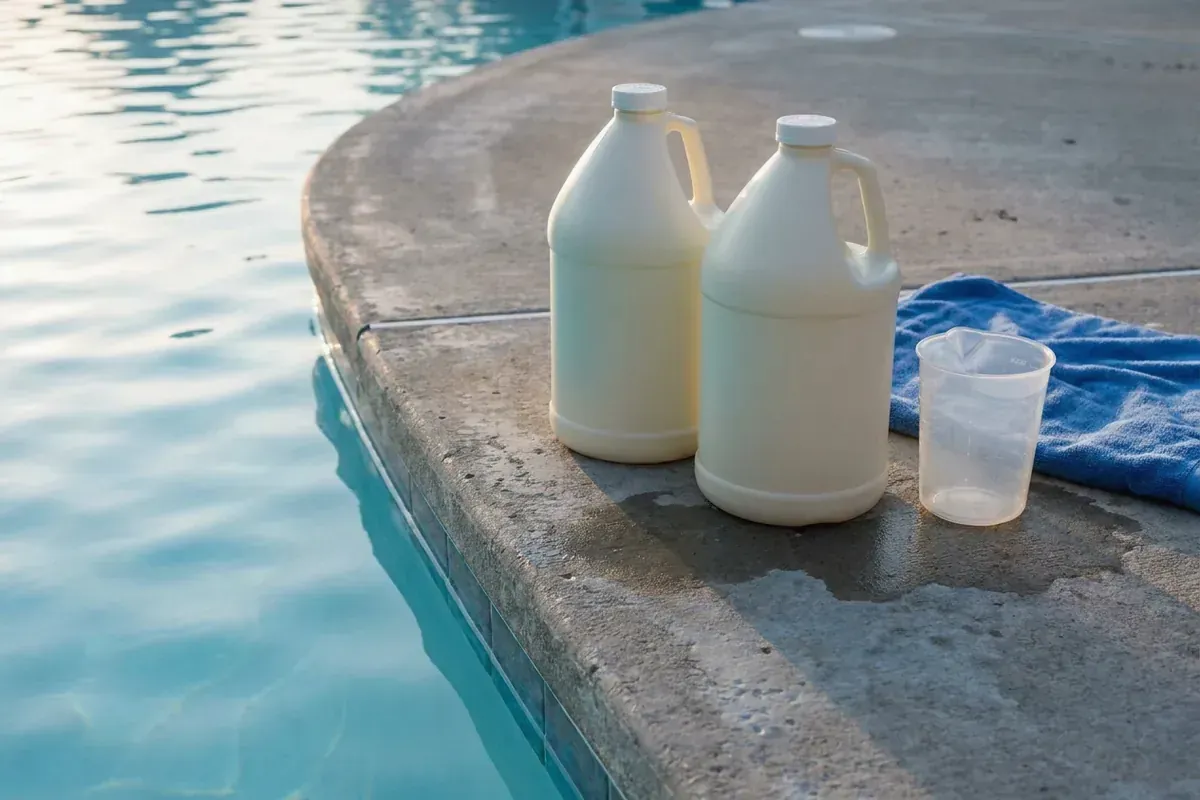
Raising free chlorine in your pool
Your stabilizer level sets your target, and stabilizer is also called cyanuric acid or CYA (the same chemical, by its full name and short name). Stabilizer keeps sunlight from burning through chlorine. With stabilizer at 30 ppm, hold free chlorine at 3 to 5 ppm. At 40 ppm, keep it between 4 and 6 ppm.
- 1. Test the water first to get your current free chlorine reading.
- 2. Figure out how far that reading sits from your target.
- 3. Scale the dose to your pool size. A 20,000 gallon pool takes double, and a 5,000 gallon pool takes half.
- 4. Start the pump, then let the chemical trickle in where a return jet pushes it out into the water, so it mixes well.
- 5. Take it one chemical at a time, and never bring acid and chlorine together.
Swimming is fine about half an hour after normal liquid chlorine doses. After a shock, hold off until the reading is back in your normal range and no higher than 10 ppm.
How much do I add for a 1 ppm rise?
| Pool size | 12.5% liquid chlorine | 65% cal-hypo |
|---|---|---|
| 5,000 gallons | about 5 fl oz | about 1 oz |
| 10,000 gallons | 10 fl oz | 2.1 oz |
| 20,000 gallons | 20 fl oz | double 2.1 oz |
Picking your chlorine
- Cal-hypo adds calcium hardness.
- Every dose of tablets or dichlor bumps your stabilizer up.
Stabilizer never breaks down, and no filter removes it. Draining and refilling water is the only way to bring it down.
Common questions
How much chlorine does a 15,000 gallon pool need?
For a 1 ppm gain, a pool that size takes roughly 15 fl oz of the 12.5% liquid product, or 3 oz of 65% cal-hypo. Scale up from there if you need a bigger jump.
What about a 3,000 gallon pool?
For each 1 ppm rise, a pool that small takes roughly 3 fl oz of the 12.5% liquid product, which works out to about a third of what a 10,000 gallon pool would use.
How can I work out my pool's volume?
Take the surface area in square feet, multiply by the average depth in feet, then multiply by 7.48. Round and oval pools use 5.9 instead. On a sloped floor, find average depth by adding shallow and deep, then divide by two. A 16 x 32 ft pool with a 4.5 ft average depth holds roughly 17,200 gallons.
Can I use liters instead?
One US gallon equals 3.785 liters, and 1 cubic meter holds 1,000 liters. In a 10,000 gallon pool, reaching 1 ppm takes roughly 305 mL of the 12.5% liquid product.
Liquid chlorine or tablets?
Tablets keep feeding while you are away, but over a season they drive stabilizer up. Follow the rate on your tablet label, and still test often, since sun and heat change how much chlorine you use.