
- Home
- Equipment
- Pump size calculator
Pool Pump Size Calculator
Size the pump by flow, not horsepower. Two answers give the gallons a minute you need.
1 of 2
The flow you need appears here.
- 8 hours
- common turnover for a home pool
- GPM
- size by flow, not HP
- Filter
- must be rated above the pump flow
To size a pool pump, a calculator looks at two numbers: how many gallons your pool holds, and how many hours a day you want the pump running. From those it works out the flow your pump must deliver to push every drop of water through the filter.
- Aim for 1 full turnover each day
- Common run time for 1 turnover: about 8 hours
- Add 1 to 2 hours in hot weather or when the pool gets heavy use
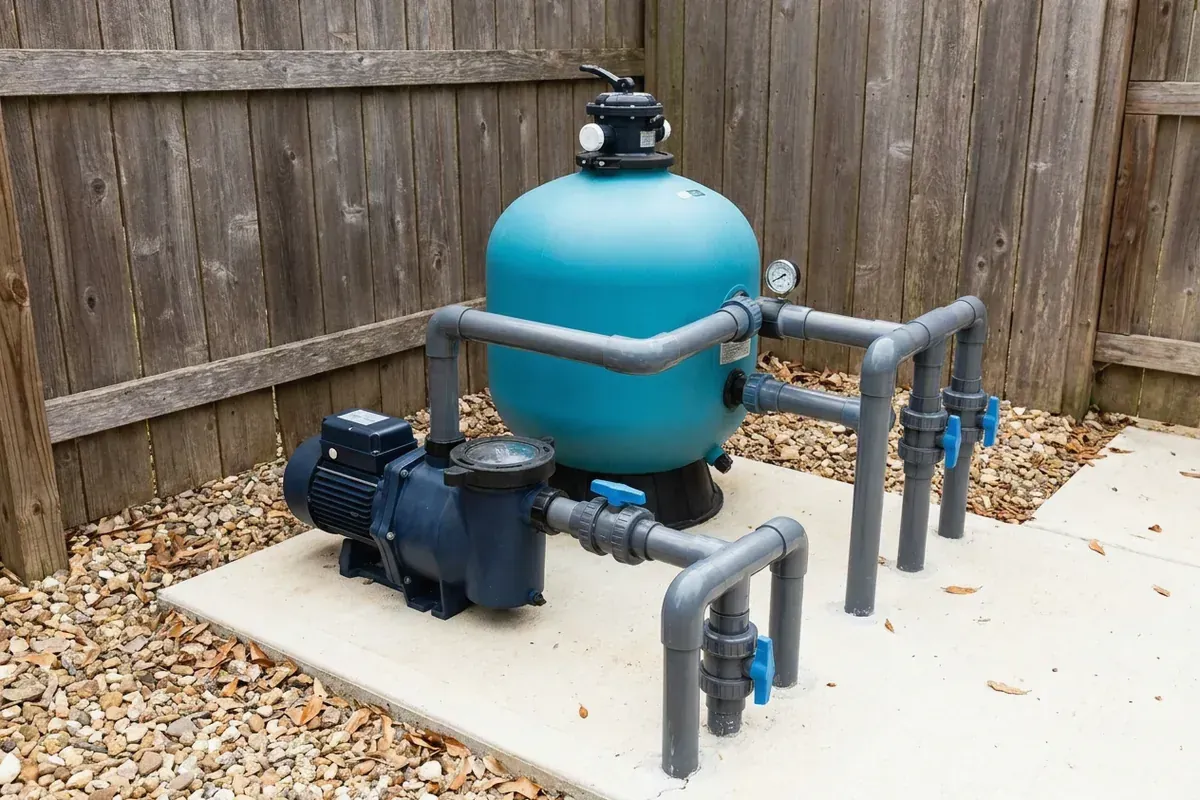
What size pool pump do I need?
Flow is the number that matters here. Pumps are rated in gallons per minute, and you'll see this written as GPM on labels and charts. Your pump's GPM has to be large enough to push all the pool's water through the filter within the hours you've chosen.
Take a 16 x 32 ft pool that averages 4.5 ft deep. That pool holds roughly 17,200 gallons. To clean all of it in 8 hours, divide the gallons by 8 and then by 60 to get the gallons a minute you need.
| Pool size (average depth 4.5 ft) | Water volume |
|---|---|
| 12 x 24 ft | roughly 9,690 |
| 16 x 32 ft | roughly 17,200 |
| 20 x 40 ft | roughly 26,900 |
You can go with a lower flow and still filter everything once a day. The trade-off is simply more hours of running.
Finding your pool's gallons
The gallon count comes first, then the pump. Work out the surface area in square feet, multiply it by the average depth in feet, and then by 7.48. Round or oval pools? Swap 5.9 in place of 7.48.
Got a sloped floor? Then the average depth is the midpoint of the shallow-end and deep-end depths. So a pool going from 3 ft down to 6 ft averages 4.5 ft.
Pool turnover rate calculator
A turnover is how long the full volume of pool water takes to make one trip through the filter. One turnover a day is the goal, and many pools get there in about 8 hours.
Divide your gallons by the pump's GPM, then by 60, and you have your hours.
When it's hot out, or the pool has had a lot of swimmers, plan on 1 to 2 extra hours of running.
Matching the filter to the pump
Whatever pump you choose, the filter has to keep up with its flow. Every filter type handles a certain GPM for each square foot of filter area. That area is the dirt-catching surface, and you'll find it on the filter's label.
| Filter type | GPM handled per sq ft of filter area |
|---|---|
| Sand | 20 |
| Diatomaceous earth | 2 |
| Cartridge | 0.375 |
Backwashing is how you clean sand and diatomaceous earth filters. That means sending water the wrong way through the filter so the dirt washes out. Do it when the pressure gauge climbs 8 to 10 psi above its clean reading.
Pool pump running cost
A single-speed pump typically runs at about 1,725 watts. Eight hours of that adds up to roughly 13.8 kWh each day.
At the average US price for electricity, 18.16 cents per kWh, from the EIA, multiply your daily kWh by that price to get your daily cost. To get your own pump's watts, multiply its label's volts by its amps.
How this is worked out
- Gallons: surface area (sq ft) × average depth (ft) × 7.48; round and oval pools swap in 5.9.
- Flow needed: gallons ÷ run time in hours ÷ 60.
- Run time: gallons ÷ pump GPM ÷ 60.
- Power use: watts ÷ 1,000 × hours the pump runs.
- One US gallon equals 3.785 liters.