
- Home
- Chemicals
- Raise alkalinity
How to Raise Alkalinity in a Pool
Plain baking soda does it. Two answers give the amount.
1 of 2: your gallons
Your dose appears here after the last question.
- 1 lb 6 oz
- per 10,000 gal for each 10 ppm
- 80 ppm
- raise it below this
- 6 hours
- wait before retesting
Plain baking soda is the easy way to raise alkalinity in a pool. For a 10,000 gallon pool, 1 lb 6 oz raises it by 10 ppm. Aim for 80 to 120 ppm. (ppm is just the number on your test strip or kit.)
- Dose: 635 g (that's 1 lb 6 oz) of baking soda for every 10,000 gallons of water, for each 10 ppm you want to add
- Target: total alkalinity sitting between 80 and 120 ppm
- Too low: any reading that comes in below 80 ppm
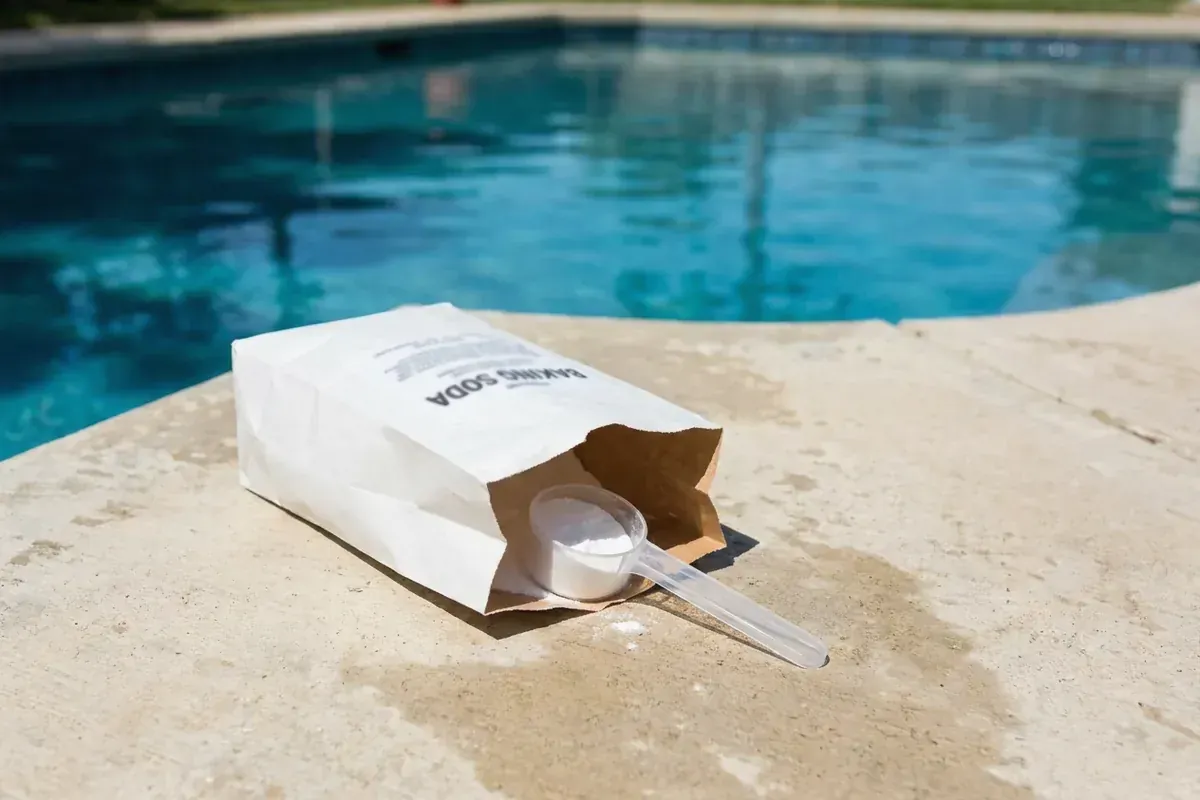
Pool alkalinity too low
When your test strip or kit reports alkalinity, that number is total alkalinity. It comes in ppm.
Anything below 80 ppm counts as too low, and you want to work your way back up to somewhere between 80 and 120 ppm. To work out the gap, take the level you want and take away your current reading. Say you test 60 ppm: that means going up 20 ppm to hit 80, or 40 ppm to hit 100.
How much baking soda should you add?
Two numbers set the dose: your pool's gallon count, and how many ppm you need to add. Each 10 ppm of increase takes 1 lb 6 oz of baking soda for every 10,000 gallons of water. Just scale the amount up or down to match the size of your pool.
Here's what that looks like at common pool sizes:
- A 5,000 gallon pool takes 11 oz for 10 ppm, 1 lb 6 oz for 20 ppm, and 2 lb 1 oz for 30 ppm.
- A 10,000 gallon pool takes 1 lb 6 oz for 10 ppm, 2 lb 12 oz for 20 ppm, and 4 lb 2 oz for 30 ppm.
- A 15,000 gallon pool takes 2 lb 1 oz for 10 ppm, 4 lb 2 oz for 20 ppm, and 6 lb 3 oz for 30 ppm.
- A 20,000 gallon pool takes 2 lb 12 oz for 10 ppm, 5 lb 8 oz for 20 ppm, and 8 lb 4 oz for 30 ppm.
- For 25,000 gallons, use about 3 lb 7 oz of baking soda for each 10 ppm increase.
- A 30,000 gallon pool takes 4 lb 2 oz for 10 ppm, 8 lb 4 oz for 20 ppm, and 12 lb 6 oz for 30 ppm.
Weigh the baking soda on a kitchen or bathroom scale instead of guessing. For example, a 20,000 gallon pool reading 60 ppm needs 20 ppm more to reach 80, which is 5 lb 8 oz.
Finding your pool's gallons
All the doses here assume US gallons. For pools around 4.5 feet deep on average, here are the usual figures:
- A 12 x 24 ft pool holds roughly 9,690 gallons.
- A 16 x 32 ft pool holds roughly 17,200 gallons.
- A 20 x 40 ft pool holds roughly 26,900 gallons.
If the floor slopes, find your average depth by splitting the difference between the shallowest point and the deepest one. So a pool going from 3 feet of water at its shallow end to 6 feet at its deep end averages 4.5 feet.
Adding the baking soda
Keep the pump running throughout so the baking soda mixes well.
- 1. Start the pump before you begin and keep it going the whole time, so the water stays in motion.
- 2. Add pool chemicals one at a time rather than together.
- 3. Tip it in near a return jet, and let the moving water spread it through every corner of the pool.
How this is worked out
If your pool size isn't listed, start from 1 lb 6 oz per 10 ppm for 10,000 gallons. Double it for 20,000 gallons, halve it for 5,000, or let the site's calculator fill in your pool's size and do the math for you.
For a rectangular pool, multiply surface area in square feet by average depth in feet by 7.48 to get gallons. If your pool is round or oval, swap 5.9 for 7.48. For a sloped floor, add the two depths together and halve the total to get the average.
For conversions, one US gallon holds 3.785 liters, and a cubic meter holds 1,000 liters.