
- Home
- Chemicals
- Pool chemical calculator
Pool Chemical Calculator
Pick what is off on your test, type the reading, and get the amount to pour or scoop.
1 of 3: your gallons
Your dose appears here after the last question.
- 7.4 to 7.6
- pH to aim for
- 80 to 120 ppm
- total alkalinity
- 30 to 50 ppm
- stabilizer for a chlorine pool
To work out a dose with this pool chemical calculator, you need three things: how many US gallons your pool holds, your latest test reading, and the strength printed on the product label.
- ppm means parts per million, the amount of a chemical in the water
- All amounts below assume US gallons
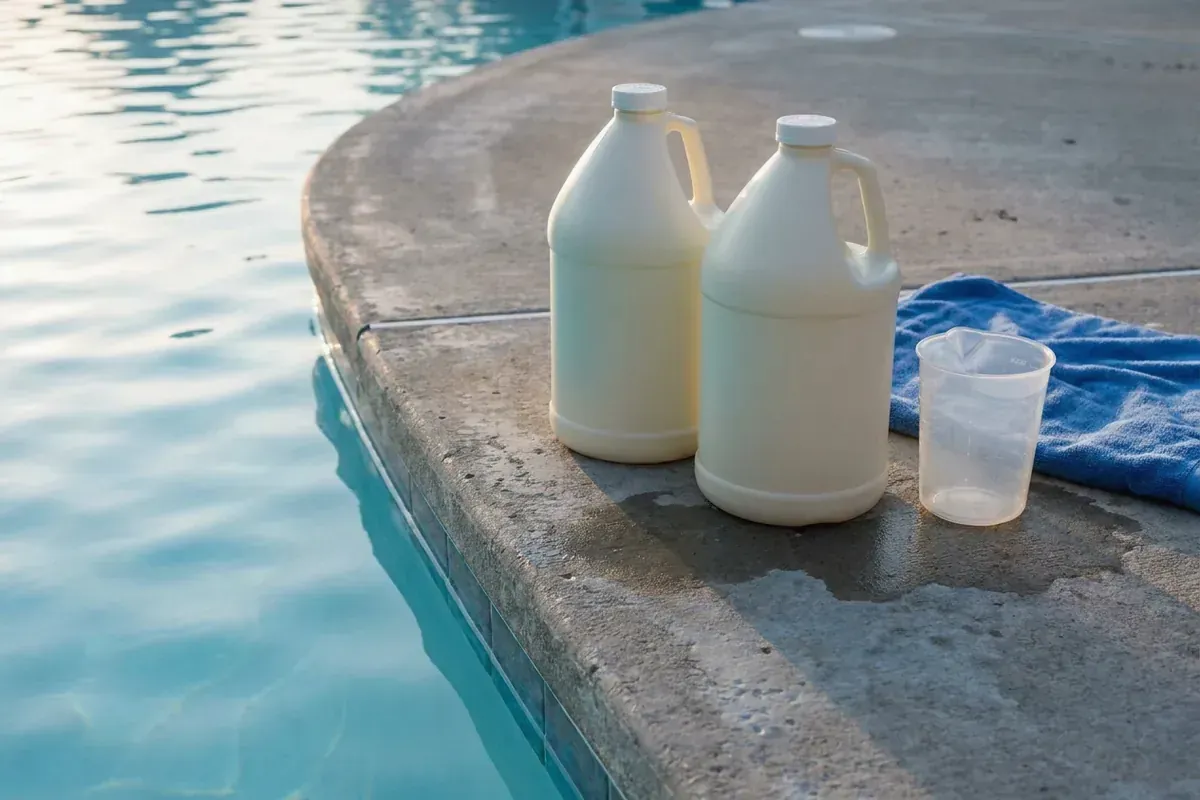
Working out your pool's volume
Each dose hinges on how much water your pool holds. For a rectangular pool, multiply the surface area in square feet by the average depth in feet, then by 7.48. For a round or oval pool, use 5.9 instead of 7.48. If the floor slopes, add the shallow and deep depths together and halve the total to get the average depth.
| Pool | Gallons | Liters |
|---|---|---|
| 12 x 24 ft rectangle, 4.5 ft average depth | 9,690 | 36,700 |
| 16 x 32 ft rectangle, 4.5 ft average depth | 17,240 | 65,200 |
| 20 x 40 ft rectangle, 4.5 ft average depth | 26,930 | 101,900 |
| 15 ft round, 48 in wall (42 in of water) | 4,630 | 17,500 |
| 18 ft round, 48 in wall (42 in of water) | 6,660 | 25,200 |
| 24 ft round, 52 in wall (46 in of water) | 12,970 | 49,100 |
| 15 x 30 ft oval, 52 in wall (46 in of water) | 10,130 | 38,400 |
| 18 x 33 ft oval, 52 in wall (46 in of water) | 13,380 | 50,600 |
If your pool is measured in liters, one US gallon equals 3.785 liters.
Levels to aim for
| Reading | Aim for | Still fine | Too low means | Too high means |
|---|---|---|---|---|
| Free chlorine | 3 to 5 ppm (parts per million) at 30 CYA | Set by your stabilizer: see the chlorine by CYA table | Algae and germs get a foothold | Red eyes, faded swimwear; swim once it is back in your stabilizer range |
| pH | 7.4 to 7.6 | 7.2 to 7.8 | Stinging eyes, etched plaster | Weaker chlorine, scale, cloudy water |
| Total alkalinity | 80 to 120 ppm | 60 to 180 ppm | pH swings | pH keeps rising |
| Calcium hardness | 200 to 400 ppm | 100 to 300 ppm in vinyl or fiberglass | Soft water eats plaster | Scale and cloudy water |
| Stabilizer (CYA) | 30 to 50 ppm | 70 to 80 ppm with a salt cell | Sun burns off chlorine | Chlorine needs to run higher |
| Salt (salt pools) | 3,000 to 3,500 ppm | 2,700 to 3,400 ppm, or your cell's label | Cell stops making chlorine | Salty taste, wear on metal |
Stabilizer is cyanuric acid, often called CYA. The more stabilizer you have, the more free chlorine you need.
Free chlorine for your stabilizer level
| Stabilizer (CYA) | Never below | Keep it at | Shock level |
|---|---|---|---|
| 0 ppm | 1 ppm | 2 to 4 ppm | 10 ppm |
| 20 ppm | 2 ppm | 2 to 4 ppm | 10 ppm |
| 30 ppm | 2 ppm | 3 to 5 ppm | 12 ppm |
| 40 ppm | 3 ppm | 4 to 6 ppm | 16 ppm |
| 50 ppm | 4 ppm | 6 to 8 ppm | 20 ppm |
| 60 ppm | 5 ppm | 7 to 9 ppm | 24 ppm |
| 70 ppm | 5 ppm | 8 to 11 ppm | 28 ppm |
| 80 ppm | 6 ppm | 9 to 12 ppm | 32 ppm |
| 90 ppm | 7 ppm | 10 to 14 ppm | 36 ppm |
| 100 ppm | 8 ppm | 11 to 15 ppm | 40 ppm |
Free chlorine follows the Trouble Free Pool chart. Salt pools run stabilizer at 70 to 80 ppm.
Amounts by pool size
The amounts below are based on the strengths listed. Chemicals come in jugs and bags, so you'll buy a full container but only pour in what your pool needs.
| What you are changing | 5,000 gal | 10,000 gal | 20,000 gal |
|---|---|---|---|
| Liquid chlorine 12.5%, free chlorine up 1 ppm | 5 fl oz | 10 fl oz | 20 fl oz |
| Liquid chlorine 10%, free chlorine up 1 ppm | 6 fl oz | 13 fl oz | 26 fl oz |
| Cal-hypo 65%, free chlorine up 1 ppm | 1 oz | 2.1 oz | 4 oz |
| Dichlor 56%, free chlorine up 1 ppm (adds 0.9 ppm stabilizer) | 1.2 oz | 2.4 oz | 5 oz |
| Trichlor tablets 90%, chlorine fed over the week (adds 0.6 ppm stabilizer per 1 ppm) | 0.7 oz | 1.5 oz | 3 oz |
| Shock: liquid chlorine 12.5%, free chlorine up 10 ppm | 51 fl oz | 102 fl oz | 1.6 gallons |
| Muriatic acid 31.45%, pH 7.8 down to 7.5 | 5 fl oz | 9 fl oz | 18 fl oz |
| Dry acid 93.2%, pH 7.8 down to 7.5 | 6 oz | 12 oz | 1 lb 9 oz |
| Soda ash, pH 7.2 up to 7.5 | 9 oz | 1 lb 1 oz | 2 lb 3 oz |
| Baking soda, alkalinity up 10 ppm | 11 oz | 1 lb 6 oz | 2 lb 13 oz |
| Muriatic acid 31.45%, alkalinity down 10 ppm | 13 fl oz | 26 fl oz | 51 fl oz |
| Cyanuric acid, stabilizer up 10 ppm | 7 oz | 13 oz | 1 lb 11 oz |
| Calcium chloride 77%, calcium up 10 ppm | 10 oz | 1 lb 3 oz | 2 lb 6 oz |
That pH dose for acid holds true only when alkalinity sits within its normal range.
Add half, let the pump mix it, test again, then add the rest: 30 minutes for chlorine, acid and soda ash, a day for baking soda and calcium, and up to a week for stabilizer. Acid always goes into water, not water into acid, and acid never meets chlorine. For your own gallons, use the pool chemical calculator or print the dosage chart.Print this page
Handling chemicals safely
- 1. Keep the pump running whenever you add something, so the water spreads the chemical through the pool.
- 2. Pour close to a return jet, the outlet where cleaned water comes back into the pool.
- 3. Add each chemical on its own, and never mix acid with chlorine.
- 4. Acid goes into water, never water into acid.
- 5. Check pH again 30 minutes after acid or soda ash.
Wait roughly half an hour after dosing liquid chlorine at normal levels before swimming. After a shock, hold off until a retest puts free chlorine back in the range your stabilizer calls for, never above 10 ppm, with pH at 7.2 to 7.8.
Your gallon count is saved
This site remembers your pool's gallons in your browser and fills them in on every dose calculator, so you only enter it once.
Questions people ask
How much chlorine does it take to shock 10,000 gallons of water?
Raising free chlorine by 10 ppm in 10,000 gallons takes 102 fluid ounces of 12.5% liquid chlorine. That's about 3 liters, or a little under a gallon.
Why won't my stabilizer drop?
Stabilizer breaks down very slowly and does not filter out, so replacing water is the usual way to lower it. To drop from 100 ppm to 50 ppm, you'd swap out about half the water.
How many hours a day should the pump run?
Let it run long enough that the full volume cycles through the filter once daily, usually around 8 hours. Add an extra hour or two when it's hot or the pool got heavy use.