
- Home
- Equipment
- Leak or evaporation?
Pool Evaporation Calculator
Set a bucket of water on the pool step for 24 hours. Two answers tell you which it is.
1 of 2
The verdict appears here.
- 1/4 inch
- average daily loss to evaporation
- 24 hours
- test length
- Pump on, then off
- repeat to find where
Use this pool evaporation calculator to find out if your pool is losing water to evaporation or to a leak. Compare how far the pool drops in a day with how far a bucket of the same water drops. If one is much bigger than the other, you likely have a leak rather than plain evaporation.
- Typical daily evaporation: around 1/4 inch
- How long the test runs: 24 hours
- Leak warning sign: over 24 hours, the pool level drops more than 1/8 inch farther than the bucket level.
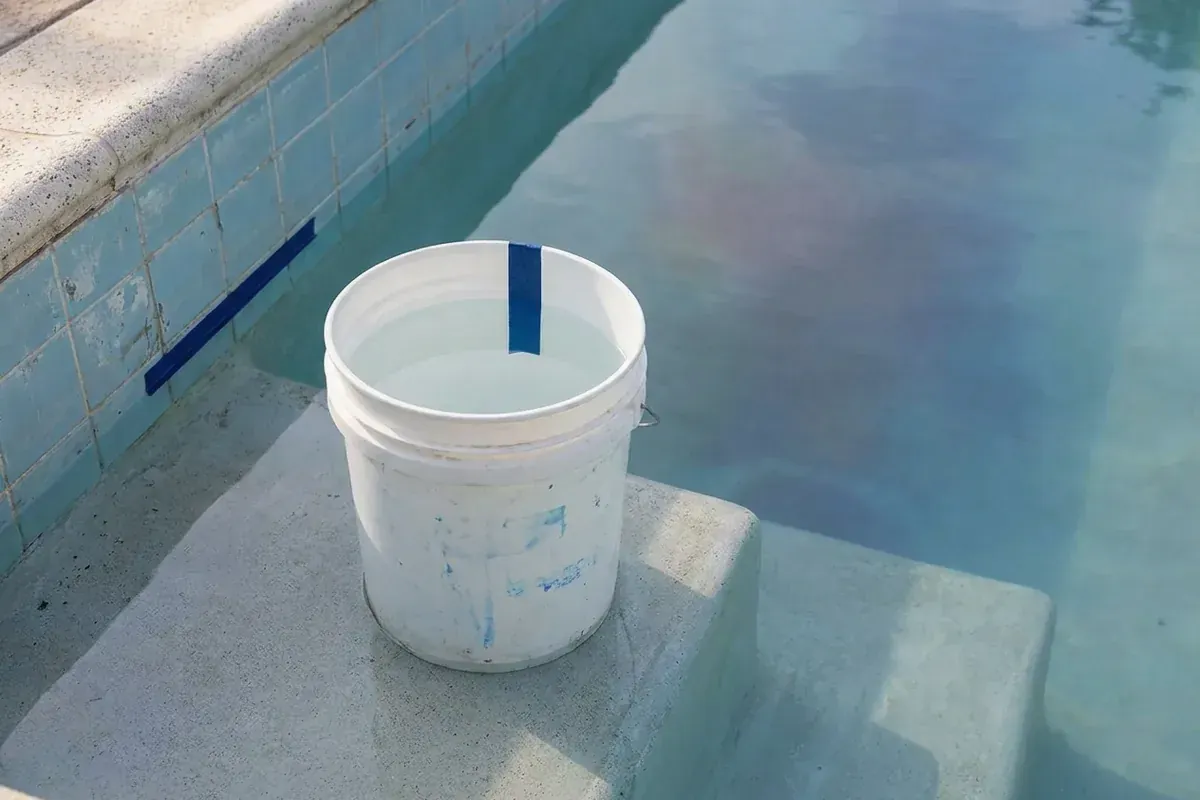
How to use a bucket to check for a leak
Water evaporates when it turns to vapor and lifts off the surface. A bucket sheds water that way too, but it has no way to leak into the soil. So the bucket gives you a fair yardstick for your pool.
- 1. Put pool water in a bucket until the level inside sits even with the pool, then place the bucket on a pool step.
- 2. Draw a line at the bucket's water level and another at the pool's level on the tile or wall, so both can be checked afterward.
- 3. Leave it for 24 hours with the pump running as usual, so the result matches an ordinary day.
- 4. Check how many inches each level went down.
The bucket helps you compare water loss over the same 24 hours. If the pool drops more than 1/8 inch farther, that points to a leak.
Leak or evaporation? Reading your result
After the 24 hours, line up the two drops. When the pool fell about as far as the bucket did, evaporation is the likeliest answer.
A pool that dropped over 1/8 inch more than the bucket points to a leak. Say the bucket lost 1/4 inch and the pool lost 1/2 inch. That difference of 1/4 inch is past the 1/8 inch line.
Normal pool evaporation rate
Latham Pool puts normal evaporation at roughly 1/4 inch a day, with more going out on windy, hot days. Expect the level to sink quicker when it's hot and breezy than when it's calm and mild.
Loss that shifts along with the weather fits the pattern of evaporation. The bucket test is the better check, since the bucket faces the same conditions.
Pool water loss by size
A quarter of an inch each day may not seem like much, but spread over a whole pool surface it becomes real volume. These numbers assume 1/4 inch of evaporation a day.
| Pool size | Gallons lost a day |
|---|---|
| 16 x 32 ft | about 80 |
Only the surface matters here, not how deep the pool is. Two pools with matching length and width will evaporate the same amount whether one is deep and one is shallow.
All figures on the site are US gallons. One US gallon equals 3.785 liters.
The math behind the numbers
You take the pool's surface area, multiply it by the drop, and convert that into gallons.
- To get the surface area in square feet, multiply length by width
- To get the drop in feet, divide the drop in inches by 12
- To get the gallons lost, multiply the surface area by the drop in feet by 7.48
For a round or oval pool, use its real surface area, and the 7.48 step stays the same.