
- Home
- Costs
- Pump running cost
How Much Does It Cost to Run a Pool Pump?
Hours a day, the watts on the motor label, your power price: the monthly cost.
1 of 3
Your monthly cost appears here.
- Volts x amps
- gives the watts
- 1,725 W
- a typical single-speed pump
- 18.16¢
- US average per kWh
The cost to run a typical single-speed pool pump 8 hours a day is about 13.8 kWh times the average US electricity rate of 18.16 cents per kWh.
- A standard single-speed pump draws about 1,725 watts
- Running 8 hours uses about 13.8 kWh
- The average US power price runs 18.16 cents per kWh
- At 8 hours a day: about 13.8 kWh times 18.16 cents each day
What you actually pay comes down to 3 things: the amount of power your pump's motor pulls, the number of hours it runs each day, and the rate your power company charges.
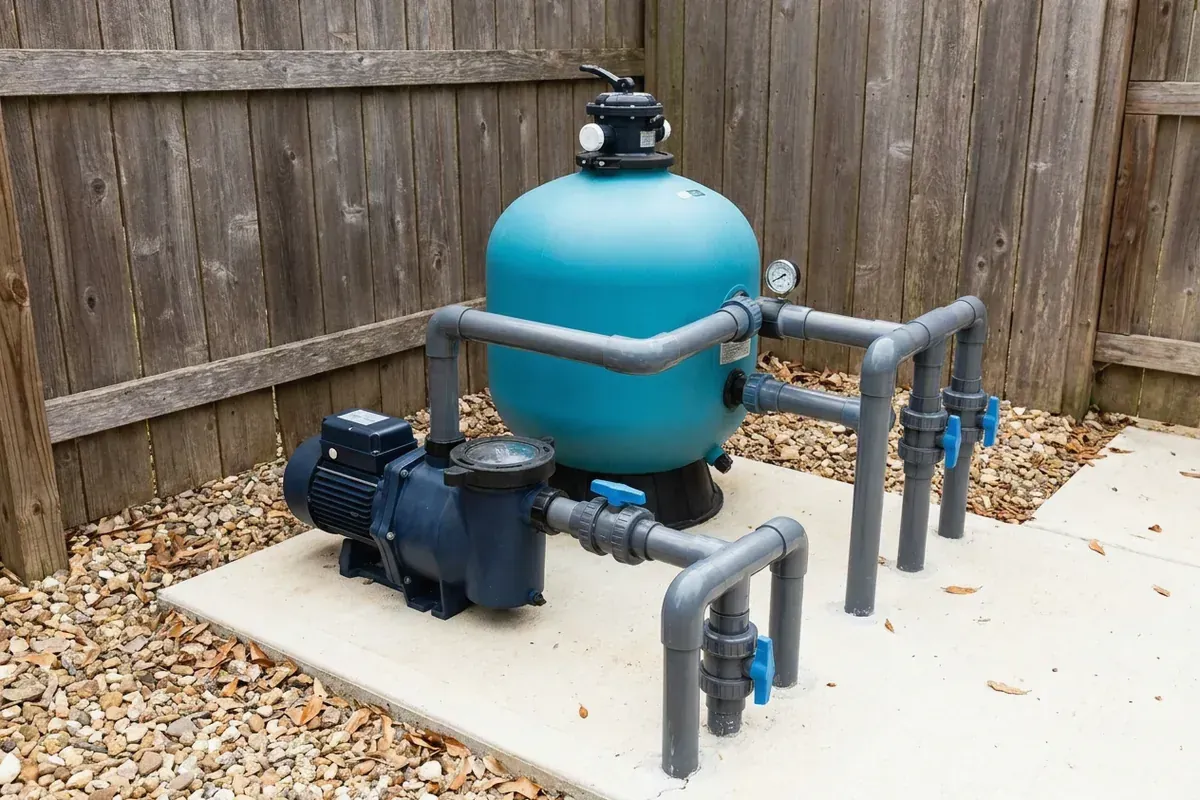
Pool pump electricity usage by daily run time
Your electric bill is measured in kWh, short for kilowatt-hours. One kWh equals a 1,000-watt motor running for 1 hour. Run the pump longer each day and you use more kWh, so your bill goes up too.
This table assumes a common single-speed pump drawing 1,725 watts, charged at the average US rate of 18.16 cents for each kWh.
| Hours daily | Power used daily | Cost per day | Cost across a month |
|---|---|---|---|
| 8 hours | about 13.8 kWh | 13.8 kWh × 18.16 cents | daily cost × 30 days |
Should your bill show a price per kWh above or below 18.16 cents, your cost moves up or down by that same percentage.
Reading pool pump kWh off the motor label
Watts tell you how much power a motor pulls while running. Check your pump's power rating, and if you have volts and amps, multiply them to estimate watts.
Say a label's volts times amps comes to about 1,725. That motor pulls about 1,725 watts, the same as the typical 1,725-watt pump this page's numbers are based on, so it would burn about 13.8 kWh over 8 hours.
To figure the kWh your own pump uses in a day, you need its watts plus the hours it runs. Your power price turns that number into dollars.
How long should a pool pump run?
Most people aim for one turnover a day. A turnover is when every gallon of water in your pool has gone through the filter one time. Many pools need about 8 hours for that.
The actual time depends on how many gallons your pool holds and your pump's flow in GPM, short for gallons per minute. Take a 17,200-gallon pool, roughly as big as a pool measuring 16 by 32 feet, with a pump pushing 40 gallons a minute. One turnover takes a bit more than 7 hours.
When it's hot out or a lot of people have been swimming, adding 1 to 2 hours keeps the water cleaner. Each extra hour adds to the daily cost for a typical pump at the average US rate.
How this is worked out
Here's how the numbers on this page were calculated.
- 1. Watts: multiply the amps by the volts printed on the label. Volts × amps = watts.
- 2. Power used each day: take the watts, divide by 1,000, then multiply by the pump's running hours. Watts ÷ 1,000 × hours = daily kWh.
- 3. Daily cost: your daily kWh times the price you pay per kWh.
- 4. Monthly cost: the daily cost times your day count, for example 30.
- 5. Turnover hours: start with the pool's gallons, split it across the pump's flow in GPM, and cut that result down by a factor of 60 to get minutes into hours. Gallons ÷ GPM ÷ 60 = hours.