
- Home
- Costs
- Cost to fill a pool
How Much Does It Cost to Fill a Pool?
Gallons times your water price, and a bucket timing for the hours. Three answers give the bill and the fill time.
1 of 3: your gallons
Your fill cost appears here.
- Per 1,000 gal
- how water bills list the price
- Sewer
- often charged on top
- Credit
- ask your utility about a pool fill
Your cost to fill a pool depends on two things: how much water your pool holds and what your water company charges for it. Bills show the cost for each 1,000 gallons, and a lot of companies tack on sewer fees too. Once you know your pool's size and can find the price on your bill, the math is simple.
- Water price: your bill shows it per 1,000 gallons
- Sewer: many bills charge this as an extra
How many gallons do pools hold?
The gallons drive most of the bill. The numbers below assume rectangular pools with a 4.5 foot average depth.
| Pool size | Roughly how many gallons |
|---|---|
| 12 by 24 feet | about 9,690 |
| 16 by 32 feet | about 17,200 |
| 20 by 40 feet | about 26,900 |
| Olympic pool (50 by 25 m, depth 2 m) | 660,000 |
Got a pool with a sloped bottom? Its average depth sits right in the middle between the shallow and deep ends. Curved shapes like rounds and ovals don't need as much water as a rectangle with matching dimensions.
Reading your water bill
Your bill prices water per 1,000 gallons. For a pool that holds 17,200 gallons, divide the gallons by 1,000, multiply by the rate on your bill, then add any sewer charge. See a sewer line on the bill? Some sewer charges are based on how much water you use, which would add to the cost of filling the pool.
How long will a hose take to fill your pool?
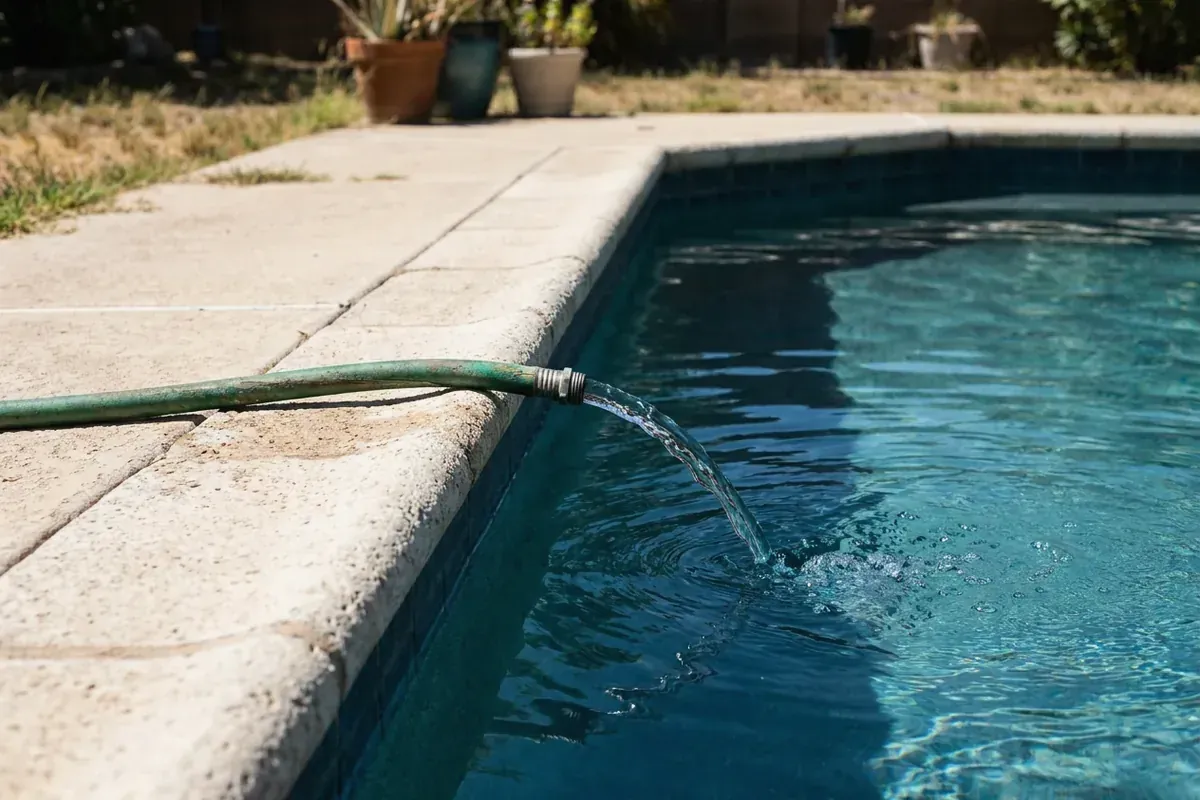
That comes down to your hose and how fast it flows. An easy check: grab a 5-gallon bucket and see how many seconds the hose needs to fill it.
- 1. Start the hose the way you would for the pool.
- 2. Fill a 5-gallon bucket under the stream and count the seconds.
- 3. That timing tells you roughly how many hours you're in for.
A 40-second bucket fill means 7.5 gallons a minute. Fill 15,000 gallons at that rate and you're looking at about 33 hours, so plan on it taking a while.
Pool water delivery cost
Suppliers set their own delivery prices, so the number you want from them is a quote for the gallons your pool actually needs. Then compare it to the tap. Figure out what those gallons cost from your water bill, using its rate for every 1,000 gallons along with any sewer fee, and set the two side by side. The gallons table works as a starting guess if your pool's size is still a mystery.
Using the fill-time calculator
You only need to give it one thing: how many seconds your hose needs to top off a 5-gallon bucket. From there it figures your gallons per minute and tells you the hours for your pool. Your browser stores your pool's gallons for the site, so entering them once is enough.
Water lost after the fill
Expect a pool to lose roughly a quarter inch of water daily to evaporation, and wind or hot weather makes it worse, per Latham Pool. Dropping faster than that? Try a bucket test. Set a water-filled bucket next to the pool, then watch how far each one falls across a full day. A gap of more than 1/8 inch between the two levels points to a possible leak.
How this is worked out
- Gallons: surface area in square feet, multiplied by average depth in feet, multiplied by 7.48 (round and oval pools use 5.9 instead).
- Average depth on a sloped bottom: shallow depth plus deep depth, then split in half.
- Fill cost: take the gallons, split them into 1,000-gallon units, multiply by your bill's rate for each unit, then add any sewer fee.
- Hose speed: 5 gallons divided by your bucket seconds, times 60, gives your flow in gallons a minute.
- Fill time: gallons divided by gallons a minute, then divided by 60, and that's your hours.
- Units: 1 US gallon equals 3.785 liters, and 1 cubic meter equals 1,000 liters.