
- Home
- Chemicals
- Pool shock calculator
Pool Shock Calculator
Routine shock or a green pool: three answers give the amount of liquid chlorine or cal-hypo.
1 of 3: your gallons
Your dose appears here after the last question.
- 102 fl oz
- liquid chlorine 12.5% for 10 ppm in 10,000 gal
- 1 lb 5 oz
- cal-hypo 65% for the same
- 40% of CYA
- free chlorine to clear green water
A pool shock calculator tells you how much chlorine it takes to raise your free chlorine by about 10 ppm (parts per million), the number your test strip or kit reads, in one go. Enter your gallons and the calculator gives you the dose. If your pool holds 10,000 gallons, plan on just over 100 fl oz of liquid chlorine.
- Liquid chlorine at 12.5%: a hair over 100 fl oz for every 10,000 gallons of water
- Cal-hypo at 65%: 1 lb 5 oz for each 10,000 gallons
- Free chlorine lift from a shock: 10 ppm
- Safe to swim: once free chlorine is back in its normal range and at 10 ppm or less
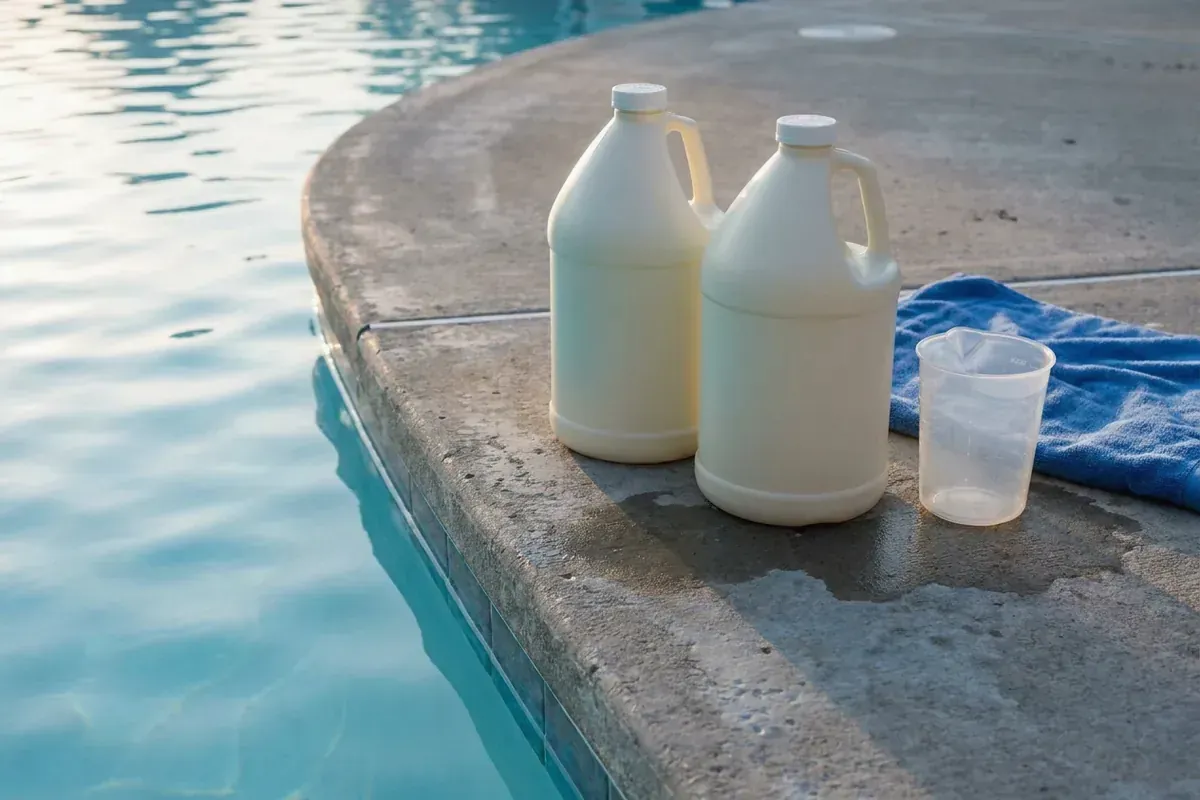
Shocking a 10,000 gallon pool
A standard shock treatment brings free chlorine up by 10 ppm. The chlorine that is still working to clean your water is called free chlorine.
For a 10,000 gallon pool, you need one of the following:
- Roughly 3.03 liters of the 12.5% liquid chlorine (that is 102 fl oz)
- Around 1 lb 5 oz of the 65% cal-hypo
Cal-hypo comes as dry granules. Add chemicals one at a time with the pump running, in front of a return jet.
Shock amounts by pool size
Each of these doses brings free chlorine up by 10 ppm. The volumes are in US gallons.
| Pool volume | 12.5% liquid chlorine | 65% cal-hypo |
|---|---|---|
| 5,000 gal | about 51 fl oz | about 10 oz |
| 10,000 gal | about 102 fl oz | about 1 lb 5 oz |
| 20,000 gal | about 205 fl oz | about 2 lb 10 oz |
Figuring out your pool's gallons
How much shock you need depends on your water volume, so start by finding your gallons. These typical shapes all assume a 4.5 ft average depth:
| Pool | Approximate gallons |
|---|---|
| 12 x 24 ft | roughly 9,690 |
| 16 x 32 ft | roughly 17,200 |
| 20 x 40 ft | roughly 26,900 |
Got a sloped floor? Then your average depth lands halfway from the shallow end over to the deep end.
How to add the shock
- 1. Keep the pump running as you add the chlorine.
- 2. Pour in front of a return jet.
- 3. Only put in one chemical at a time, and never mix acid with chlorine.
How long after shocking a pool can you swim?
Give it time until free chlorine drops back into its normal range, never above 10 ppm, and check the water before letting anyone in. Your normal chlorine level depends on your stabilizer (cyanuric acid, or CYA), a chemical that protects chlorine from being burned off by sunlight.
- For routine care, this site targets free chlorine of 3 to 5 ppm when stabilizer is at 30 ppm.
- With stabilizer at 40 ppm, aim for free chlorine of 4 to 6 ppm.
After a regular, small amount of liquid chlorine, swimming is usually fine again in roughly half an hour.
How the numbers are worked out
The site begins with the 10,000 gallon dose and adjusts it up or down to match your pool. So a 20,000 gallon pool needs twice as much, and a 5,000 gallon pool needs half. To find your gallons, take the surface area in square feet, multiply by your average depth in feet, then multiply by 7.48. If your pool is round or oval, use 5.9 instead of 7.48. Every dose here is based on US gallons.
Common questions
How much shock for a 1,000 gallon pool?
For 1,000 gallons, a 10 ppm shock takes about 10 fl oz of liquid chlorine at 12.5%, or a touch over 2 oz of 65% cal-hypo.
How much water does 1 lb of pool shock treat?
One pound of 65% cal-hypo shocks about three quarters of a 10,000 gallon pool.
Using liquid chlorine for a small 1 ppm bump
To raise free chlorine by just 1 ppm in 10,000 gallons, add 10 fl oz (305 mL) of 12.5% liquid chlorine. That's the amount for everyday top-ups, and a full shock takes about ten times as much.
Can the doses be worked in liters?
Yes. If your pool volume is in liters, divide it by 3.785 to enter it in US gallons.